The income tax slabs 2025-26 bring major changes for individual taxpayers in India. The Union Budget 2025 introduced lower tax rates under the new tax regime, increased the income tax rebate limit to ₹12 lakh and raised the tax-free income limit for salaried individuals to ₹12.75 lakh after the standard deduction. These changes apply from 1 April 2025 and cover income earned during the financial year 2025-26.
The Indian income tax system offers two tax regimes: the new tax regime and the old tax regime. Each regime has different tax rates, deductions and exemptions. The new regime offers lower tax rates with fewer deductions, while the old regime allows taxpayers to claim several tax benefits.
Choosing the right regime can help reduce your tax liability. This article explains the income tax slabs 2025-26, new and old tax rates, Section 87A rebate, standard deductions, tax calculations and key rules for Indian taxpayers.
Income Tax Slabs 2025-26
For FY 2025-26, the new tax regime has seven income slabs, starting with zero tax up to ₹4 lakh and a 30% rate above ₹24 lakh. Resident individuals with taxable income up to ₹12 lakh can claim a rebate of up to ₹60,000 under Section 87A.
1. What Are Income Tax Slabs?
Income tax slabs are income ranges that determine the rate of tax a person must pay to the government. The Income Tax Department uses these slabs to calculate the tax payable on an individual’s taxable income.
India follows a progressive tax system. This means higher portions of income attract higher tax rates. A taxpayer does not pay the highest tax rate on their entire income.
For example, under the new tax regime, a person earning ₹10 lakh does not pay 10% tax on the full ₹10 lakh. The first ₹4 lakh attracts no tax, the next ₹4 lakh attracts 5%, and the remaining ₹2 lakh attracts 10%.
The government may revise tax slabs through the Union Budget. The income tax slabs 2025-26 reflect the changes announced in the Union Budget 2025.
2. Financial Year 2025-26 and Assessment Year 2026-27
Before checking the tax rates, it is important to know the difference between a financial year and an assessment year.Term Period or Meaning Financial Year (FY) 2025-26 1 April 2025 to 31 March 2026 Assessment Year (AY) 2026-27 Year in which income earned during FY 2025-26 is assessed Previous Year Another term for the financial year in which income is earned Tax Return Return filed to report income and calculate tax liability
For example, salary earned between April 2025 and March 2026 belongs to FY 2025-26. You report this income in your income tax return for AY 2026-27.
The revised tax rates announced in Budget 2025 apply from FY 2025-26.
3. New Tax Regime Slabs for FY 2025-26
The new tax regime offers lower tax rates and a higher basic exemption limit. The government revised these rates in Budget 2025 to reduce the tax burden on individual taxpayers.
Under Section 115BAC, the new tax regime is the default tax regime for eligible taxpayers.
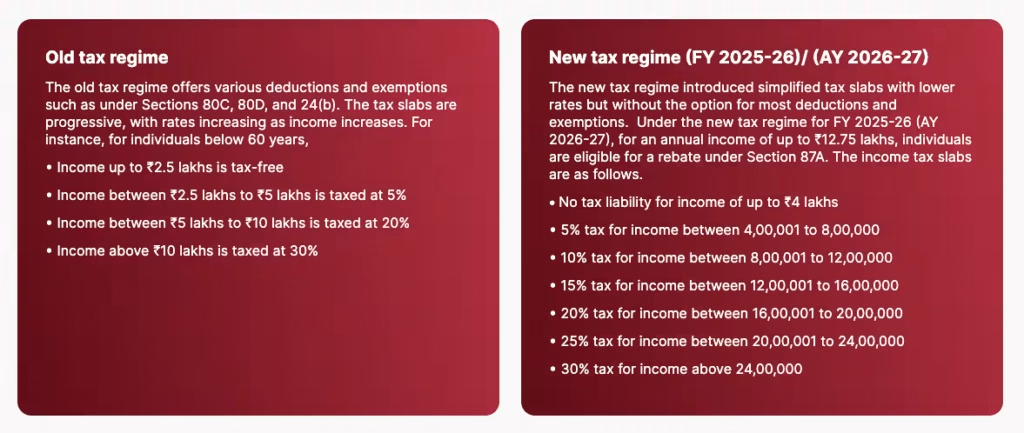
New Tax Regime Income Tax Slab Table 2025-26
| Annual Taxable Income | Income Tax Rate |
|---|---|
| Up to ₹4,00,000 | Nil |
| ₹4,00,001 to ₹8,00,000 | 5% |
| ₹8,00,001 to ₹12,00,000 | 10% |
| ₹12,00,001 to ₹16,00,000 | 15% |
| ₹16,00,001 to ₹20,00,000 | 20% |
| ₹20,00,001 to ₹24,00,000 | 25% |
| Above ₹24,00,000 | 30% |
These rates apply to individuals, including salaried employees, self-employed individuals and senior citizens.
Important Points About the New Tax Regime
- The basic exemption limit is ₹4 lakh.
- The highest slab rate is 30%.
- The 30% rate applies to income above ₹24 lakh.
- The Section 87A rebate limit is ₹12 lakh for eligible resident individuals.
- Salaried employees can claim a standard deduction of ₹75,000.
- Most common deductions, such as Section 80C and Section 80D, are not available.
- The new tax regime is the default option.
The new tax structure reduces tax rates across several income ranges. It also allows many salaried taxpayers to earn up to ₹12.75 lakh without paying income tax, subject to the applicable rebate rules and income conditions.
4. Old Tax Regime Slabs for FY 2025-26
The old tax regime continues to be available for eligible taxpayers. It offers several deductions and exemptions that can reduce taxable income.
Unlike the new regime, the old regime has different basic exemption limits for resident individuals based on age.
Old Tax Regime Slabs for Individuals Below 60 Years
| Annual Taxable Income | Income Tax Rate |
|---|---|
| Up to ₹2,50,000 | Nil |
| ₹2,50,001 to ₹5,00,000 | 5% |
| ₹5,00,001 to ₹10,00,000 | 20% |
| Above ₹10,00,000 | 30% |
Old Tax Regime Slabs for Senior Citizens
Resident individuals aged 60 years or above but below 80 years receive a higher basic exemption limit.Annual Taxable Income Income Tax Rate Up to ₹3,00,000 Nil ₹3,00,001 to ₹5,00,000 5% ₹5,00,001 to ₹10,00,000 20% Above ₹10,00,000 30%
Old Tax Regime Slabs for Super Senior Citizens
Resident individuals aged 80 years or above receive an additional tax benefit under the old regime.Annual Taxable Income Income Tax Rate Up to ₹5,00,000 Nil ₹5,00,001 to ₹10,00,000 20% Above ₹10,00,000 30%
Note: The higher basic exemption limits for senior and super senior citizens under the old regime apply to resident individuals. Non-resident individuals do not receive these age-based higher exemption limits.
5. New Tax Regime vs Old Tax Regime: Key Differences
Both tax regimes calculate income tax using different slab rates and tax benefits. The best option depends on your income, investments, deductions and exemptions.
Here is a comparison of the two regimes for FY 2025-26.Feature New Tax Regime Old Tax Regime Basic exemption limit ₹4 lakh ₹2.5 lakh Tax rebate limit ₹12 lakh ₹5 lakh Maximum Section 87A rebate ₹60,000 ₹12,500 Standard deduction for salary ₹75,000 ₹50,000 Section 80C deduction Not available Available Section 80D deduction Not available Available HRA exemption Not available Available Home loan interest on self-occupied property Not available under Section 24(b) Available up to ₹2 lakh, subject to conditions Tax rates Lower Higher Default tax regime Yes No
Which Tax Regime Should You Choose?
The new regime may suit people who:
- Have limited tax-saving investments.
- Do not claim many deductions.
- Prefer lower tax rates.
- Want a simpler tax calculation.
- Have salary income and benefit from the higher standard deduction.
The old regime may suit people who:
- Invest regularly under Section 80C.
- Pay health insurance premiums.
- Receive House Rent Allowance (HRA).
- Have eligible home loan interest payments.
- Claim several tax deductions and exemptions.
Compare your total tax liability under both regimes before making a decision.
Also Read: Rectification of Mistakes in Income Tax Orders under Sec. 154 – Process, Time Limits & Appeals
6. Section 87A Rebate: No Tax Up to ₹12 Lakh
One of the biggest changes in the income tax slabs 2025-26 is the increase in the Section 87A rebate.
The Union Budget 2025 raised the rebate limit under the new tax regime from ₹7 lakh to ₹12 lakh.
This benefit helps eligible resident individual taxpayers reduce their income tax to zero.
Section 87A Rebate Details for FY 2025-26
| Particulars | New Tax Regime |
|---|---|
| Maximum eligible taxable income | ₹12,00,000 |
| Maximum rebate | ₹60,000 |
| Rebate percentage | 100% of eligible income tax |
| Applicable section | Section 87A |
A resident individual with taxable income up to ₹12 lakh can claim a rebate of up to ₹60,000. The rebate reduces the income tax payable to zero when the tax falls within the eligible limit.
Example: Section 87A Rebate Calculation
Suppose a resident individual has taxable income of ₹12 lakh under the new regime.Income Range Tax Rate Tax Amount First ₹4 lakh 0% ₹0 Next ₹4 lakh 5% ₹20,000 Next ₹4 lakh 10% ₹40,000 Total Tax ₹60,000 Section 87A Rebate ₹60,000 Final Income Tax ₹0
Therefore, the taxpayer does not have to pay income tax on ₹12 lakh of eligible normal taxable income.
Important: The rebate is available only to resident individuals. It does not apply to tax payable on special-rate income, such as certain capital gains. The ₹12 lakh limit is not a blanket exemption for every type of income.
7. Standard Deduction for Salaried Employees
The standard deduction reduces taxable salary income. Salaried employees and eligible pensioners can claim this deduction without submitting investment proof for it.
For FY 2025-26, the standard deduction amounts are:Tax Regime Standard Deduction New Tax Regime ₹75,000 Old Tax Regime ₹50,000
How Does the ₹12.75 Lakh Tax-Free Income Limit Work?
Under the new regime, a salaried employee can claim a standard deduction of ₹75,000.
For example:
- Annual salary: ₹12,75,000
- Standard deduction: ₹75,000
- Taxable income: ₹12,00,000
- Income tax before rebate: ₹60,000
- Section 87A rebate: ₹60,000
- Final income tax: ₹0
This is why salaried taxpayers can have zero income tax on salary income up to ₹12.75 lakh under the new regime.
This calculation assumes eligible normal salary income and no other income that changes the tax liability.
8. Income Tax Calculation Examples for FY 2025-26
The following examples show how the new tax regime works for different income levels.
These calculations assume that the income is normal taxable income, the taxpayer is a resident individual and no special-rate income or surcharge applies.
Example 1: Annual Income of ₹8 Lakh
| Income Range | Tax Rate | Tax |
|---|---|---|
| Up to ₹4 lakh | 0% | ₹0 |
| ₹4 lakh to ₹8 lakh | 5% | ₹20,000 |
| Total Tax | ₹20,000 | |
| Section 87A Rebate | ₹20,000 | |
| Final Tax | ₹0 |
Example 2: Annual Income of ₹10 Lakh
| Income Range | Tax Rate | Tax |
|---|---|---|
| Up to ₹4 lakh | 0% | ₹0 |
| ₹4 lakh to ₹8 lakh | 5% | ₹20,000 |
| ₹8 lakh to ₹10 lakh | 10% | ₹20,000 |
| Total Tax | ₹40,000 | |
| Section 87A Rebate | ₹40,000 | |
| Final Tax | ₹0 |
Example 3: Annual Income of ₹12 Lakh
| Income Range | Tax Rate | Tax |
|---|---|---|
| Up to ₹4 lakh | 0% | ₹0 |
| ₹4 lakh to ₹8 lakh | 5% | ₹20,000 |
| ₹8 lakh to ₹12 lakh | 10% | ₹40,000 |
| Total Tax | ₹60,000 | |
| Section 87A Rebate | ₹60,000 | |
| Final Tax | ₹0 |
Example 4: Annual Income of ₹15 Lakh
| Income Range | Tax Rate | Tax |
|---|---|---|
| Up to ₹4 lakh | 0% | ₹0 |
| ₹4 lakh to ₹8 lakh | 5% | ₹20,000 |
| ₹8 lakh to ₹12 lakh | 10% | ₹40,000 |
| ₹12 lakh to ₹15 lakh | 15% | ₹45,000 |
| Total Tax | ₹1,05,000 | |
| Section 87A Rebate | ₹0 | |
| Health and Education Cess (4%) | ₹4,200 | |
| Final Tax | ₹1,09,200 |
These examples show that tax rates apply to each income portion, not to the full income at one rate.
9. Tax Deductions Available Under the Old Tax Regime
The old tax regime allows taxpayers to claim several deductions and exemptions. These benefits can reduce taxable income and lower the final tax amount.
Some major deductions include:
1. Section 80C
Section 80C allows eligible individuals and Hindu Undivided Families (HUFs) to claim deductions up to ₹1.5 lakh in a financial year.
Eligible investments and payments include:
- Public Provident Fund (PPF).
- Employees’ Provident Fund (EPF).
- Life insurance premiums.
- Equity Linked Savings Schemes (ELSS).
- National Savings Certificate (NSC).
- Five-year tax-saving fixed deposits.
- Eligible tuition fees for children.
- Principal repayment of a qualifying home loan.
2. Section 80D
This section provides deductions for eligible health insurance premiums and certain medical expenses.
The deduction limits depend on the age of the insured person and the applicable conditions.
3. House Rent Allowance (HRA)
Salaried employees who receive HRA can claim an exemption under Section 10(13A), subject to the prescribed conditions.
The exemption depends on salary, actual HRA received and rent paid.
4. Home Loan Interest Deduction
Under Section 24(b), taxpayers can claim interest paid on eligible home loans.
For a self-occupied house property, the maximum deduction is generally ₹2 lakh, subject to conditions.
5. National Pension System (NPS)
Eligible taxpayers can claim an additional deduction of up to ₹50,000 under Section 80CCD(1B) under the old regime.
6. Education Loan Interest
Section 80E allows a deduction for eligible interest paid on an education loan. There is no fixed monetary ceiling, but the deduction is subject to the section’s conditions and time limit.
Note: Most of these deductions are not available under the new tax regime. Some specific deductions and exemptions remain available under the new regime, subject to the relevant provisions.
10. Surcharge and Health and Education Cess
Income tax does not always end with the basic tax amount. Eligible taxpayers may also have to pay a surcharge and Health and Education Cess.
Health and Education Cess
The government charges Health and Education Cess at 4% on income tax plus surcharge, where applicable.
For example:
- Income tax: ₹50,000
- Cess at 4%: ₹2,000
- Total tax: ₹52,000
Surcharge Rates
A surcharge applies when total income crosses specified limits.
The general surcharge rates for individuals are:Total Income Old Tax Regime New Tax Regime Up to ₹50 lakh Nil Nil Above ₹50 lakh to ₹1 crore 10% 10% Above ₹1 crore to ₹2 crore 15% 15% Above ₹2 crore to ₹5 crore 25% 25% Above ₹5 crore 37% 25%
Special rules apply to certain types of income, including dividends and capital gains. Marginal relief may also apply in eligible cases.
11. Marginal Relief Under the New Tax Regime
Marginal relief protects taxpayers whose income is slightly above the ₹12 lakh rebate limit.
Without marginal relief, a small increase in income could result in a much higher tax liability because the taxpayer would lose the full Section 87A rebate.
Under the new regime, eligible resident individuals can claim marginal relief when taxable income exceeds ₹12 lakh.
The relief limits the tax payable to the amount by which income exceeds ₹12 lakh, subject to the applicable calculation.
For example, consider a resident individual with taxable income of ₹12.10 lakh.
The income exceeds the rebate limit by ₹10,000. Marginal relief ensures that the tax liability does not exceed the applicable excess amount before the relevant cess calculation.
This rule prevents a sudden increase in tax for people whose income is just above the rebate limit.
12. Which Tax Regime Is Better for Salaried Employees?
There is no single answer for every employee. The right choice depends on salary, deductions, investments and other income.
The new regime offers lower tax rates and a higher standard deduction. The old regime offers more deductions and exemptions.
Consider these points before selecting a regime:
- Calculate your annual taxable salary.
- Check your eligible Section 80C investments.
- Add health insurance deductions under Section 80D.
- Calculate your eligible HRA exemption.
- Include eligible home loan interest.
- Compare the total tax under both regimes.
- Select the regime that gives you a lower tax liability.
For employees with few deductions, the new regime may offer a lower tax bill.
Employees who claim large deductions may find the old regime more useful.
Use the Income Tax Department’s official tax calculator to compare both options.
13. How to Choose Your Tax Regime
The tax regime choice depends on your income and eligibility.
For individuals without business or professional income, the choice can generally be changed each year by selecting the preferred regime in the income tax return filed by the due date under Section 139(1).
For individuals with business or professional income, additional rules apply.
They must submit Form 10-IEA within the prescribed time to opt out of the new regime. The option to switch back to the new regime is restricted and is generally available only once, subject to the applicable rules.
Steps to Compare Both Tax Regimes
- Calculate your gross annual income.
- Identify your eligible deductions and exemptions.
- Calculate taxable income under the old regime.
- Calculate taxable income under the new regime.
- Apply the correct slab rates.
- Check your Section 87A rebate eligibility.
- Add surcharge and cess, if applicable.
- Compare the final tax amounts.
Do not select a regime only because it has lower slab rates. Check the full tax calculation before making your choice.
14. Important Changes in Budget 2025 for Income Taxpayers
The Union Budget 2025 introduced several changes to personal income tax under the new regime.
The main changes include:
- The basic exemption limit increased from ₹3 lakh to ₹4 lakh.
- The 5% tax slab now covers income from ₹4 lakh to ₹8 lakh.
- The 10% tax slab covers income from ₹8 lakh to ₹12 lakh.
- The 15% tax slab covers income from ₹12 lakh to ₹16 lakh.
- The 20% tax slab covers income from ₹16 lakh to ₹20 lakh.
- The 25% tax slab covers income from ₹20 lakh to ₹24 lakh.
- The 30% tax rate applies to income above ₹24 lakh.
- The Section 87A rebate limit increased to ₹12 lakh.
- The maximum rebate increased to ₹60,000.
- The standard deduction for salaried employees under the new regime remains ₹75,000.
These changes apply from FY 2025-26, which corresponds to AY 2026-27.
15. Who Should Pay Income Tax in India?
Income tax applies to individuals and other taxable entities based on their income and the provisions of the Income Tax Act.
An individual’s tax liability depends on factors such as:
- Residential status.
- Total taxable income.
- Income from salary.
- Income from house property.
- Business or professional income.
- Capital gains.
- Income from other sources.
- Eligible deductions and exemptions.
Even when tax payable is zero, a taxpayer may still need to file an income tax return if the applicable filing conditions require it.
Some taxpayers must file returns due to specific conditions, even when their income is below the basic exemption limit.
For example, certain high-value transactions, foreign assets and other prescribed conditions can create a return filing requirement.
16. How to File an Income Tax Return for FY 2025-26
Taxpayers can file their income tax returns through the official Income Tax e-Filing portal.
Follow these general steps:
- Visit the Income Tax e-Filing portal.
- Log in using your PAN credentials.
- Select the applicable assessment year, AY 2026-27.
- Choose the correct income tax return form.
- Review your personal and income details.
- Check Form 16, Form 26AS and the Annual Information Statement (AIS).
- Select the applicable tax regime.
- Report salary, business income, capital gains and other income.
- Claim eligible deductions and exemptions.
- Calculate your tax liability.
- Pay any remaining tax, if applicable.
- Submit the return.
- Complete e-verification within the prescribed period.
Keep your bank details, PAN, Aadhaar, Form 16, investment records and income statements ready before filing.
The return form depends on your income sources and other eligibility conditions.
17. Common Mistakes to Avoid While Calculating Income Tax
Taxpayers should avoid common errors when using the income tax slabs 2025-26.
- Using the wrong financial year: Use FY 2025-26 for income earned between April 2025 and March 2026.
- Confusing FY and AY: The corresponding assessment year is AY 2026-27.
- Applying one rate to total income: Tax is calculated separately for each slab.
- Ignoring the standard deduction: Eligible salaried taxpayers should include it in their calculation.
- Claiming deductions under the wrong regime: Most common deductions are not available under the new regime.
- Ignoring Section 87A conditions: The rebate is available only to eligible resident individuals.
- Forgetting special-rate income: Certain capital gains and other income may have separate tax rates.
- Ignoring cess: Add 4% Health and Education Cess to the applicable tax and surcharge.
- Not checking AIS and Form 26AS: These records help identify reported income and tax credits.
- Missing the return filing deadline: File your return within the applicable due date.
Correct income reporting and regime selection can help avoid tax errors and notices.
18. Frequently Asked Questions About Income Tax Slabs 2025-26
1. What are the new income tax slabs for FY 2025-26?
The new tax regime has seven slabs. Income up to ₹4 lakh is tax-free. The rates are 5%, 10%, 15%, 20%, 25% and 30% across the higher income ranges.
2. Is income up to ₹12 lakh tax-free in FY 2025-26?
Yes. Eligible resident individuals with normal taxable income up to ₹12 lakh can claim a Section 87A rebate of up to ₹60,000 under the new regime. Special-rate income is subject to separate rules.
3. Is income up to ₹12.75 lakh tax-free for salaried employees?
Yes. Salaried employees can claim a standard deduction of ₹75,000 under the new regime. This can reduce salary income of ₹12.75 lakh to taxable income of ₹12 lakh, which qualifies for the Section 87A rebate if the other conditions are met.
4. What is the basic exemption limit under the new tax regime?
The basic exemption limit is ₹4 lakh for FY 2025-26.
5. What is the basic exemption limit under the old tax regime?
For individuals below 60 years, it is ₹2.5 lakh. For resident senior citizens aged 60 to below 80 years, it is ₹3 lakh. For resident super senior citizens aged 80 years or above, it is ₹5 lakh.
6. What is the maximum rebate under Section 87A for FY 2025-26?
The maximum rebate is ₹60,000 under the new tax regime for eligible resident individuals whose taxable income does not exceed ₹12 lakh.
Under the old regime, the maximum rebate is ₹12,500 for eligible resident individuals whose taxable income does not exceed ₹5 lakh.
7. Is the new tax regime compulsory?
No. It is the default regime, but eligible taxpayers can opt for the old regime by following the prescribed rules.
8. Can I claim Section 80C under the new tax regime?
No. The Section 80C deduction is not available under the new tax regime. Eligible taxpayers can claim it under the old regime, up to ₹1.5 lakh.
9. Can senior citizens use the new tax regime?
Yes. The new tax regime is available to senior and super senior citizens. It uses the same income tax slab rates regardless of age.
10. What is the standard deduction for FY 2025-26?
The standard deduction is ₹75,000 under the new regime and ₹50,000 under the old regime for eligible salaried taxpayers and pensioners.
11. What is the highest income tax rate in India for FY 2025-26?
The highest basic income tax rate under both regimes is 30%. Surcharge and cess may increase the final tax liability.
12. Which assessment year applies to FY 2025-26?
The assessment year is AY 2026-27.
13. Is the 4% cess applicable under both tax regimes?
Yes. Health and Education Cess at 4% applies to the income tax and surcharge, if any, under both regimes.
14. Can I change my tax regime every year?
Individuals without business or professional income can generally choose a regime each year in their income tax return. Taxpayers with business or professional income must follow additional restrictions and filing requirements.
15. Do I need to file an ITR if my income is below ₹12 lakh?
A zero tax liability does not automatically remove the requirement to file an income tax return. Filing depends on the applicable conditions under the Income Tax Act.
The income tax slabs 2025-26 offer significant relief to individual taxpayers under the new tax regime. The revised slabs, higher Section 87A rebate and ₹75,000 standard deduction make the new regime useful for many salaried employees and individuals.
However, the old regime remains an option for taxpayers who claim substantial deductions and exemptions.
Before choosing a regime, calculate your tax under both options. Check your salary, investments, home loan interest, insurance premiums and other eligible deductions. A correct comparison can help you select the right tax regime and avoid paying more tax than necessary.